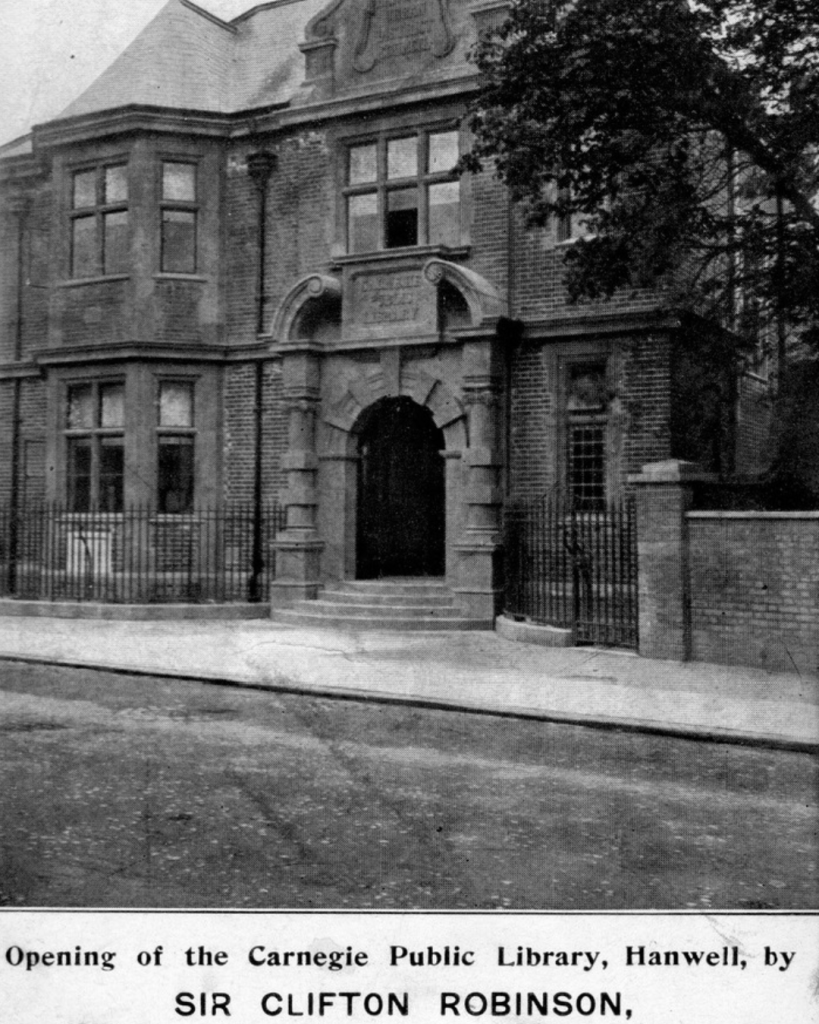
After Brentford Council received a grant from the Carnegie Fund in 1902 for a library, Hanwell councillors took notice. They wrote to Carnegie’s secretary and were given £2,500, later rising to £3,000, to have the library building built. The library was constructed between 1904-1905, opening on Cherington Road. A site in Hanwell Broadway had been proposed, but turned down.
Lady Jersey laid the foundation stone at Hanwell Library in 1904. Local organisations such as the Hanwell Fire Brigade turned out and there was the local band, too. The opening, a year later, was by the chairman of the London United Electric Tramways Company, Clifton Robinson.
For staff, there was one professional librarian, Frank Pocock, and a young man who assisted him. New editions of the catalogues were also created. A reader would then check with staff if the book was available or not, and if it was it could be issued. No browsing was allowed. Very few books were lost using this system. Magazines and newspapers were available on racks in the reading room.
Many books and magazines were donated by the public to fill the library stock. They were even offered, and accepted, ancient Celtic stakes. Early library minute books were dominated by the need to save money and make it where possible. Salaries for non-professional staff were very low.
Long opening hours
The library was open six days a week from 10am to 8pm except on Thursdays, when closing time was 1pm. The newspaper room was open even longer, from 9am to 8.30pm. The newspaper room was deemed important because part of the intended market was the working man and he could only get there on an evening.
- In 1905-6, 2,965 books were borrowed at Hanwell Library
- In 1906-1907 it was 54,107
- In 1921-1922 it was 68, 369.
Sadly Frank Pocock, Hanwell’s first librarian, did not live to see this. He enlisted in the army in the First World War and was unfortunate enough to be killed on active service in 1918.
Photo shows Hanwell Library, 1905.
About the author
Thank you to Dr Jonathan Oates for providing this information from his extensive writing on the history of Ealing.
Dr Jonathan Oates is the Borough Archivist for Ealing Council. He holds a PhD in History from the University of Reading and is the author of more than twenty books covering London’s history, local and family history, military history and true crime.
His books on the local area include Ealing: A Concise History, Acton: A History, Southall and Hanwell: History and Guide and Ealing: A Potted History (co-authored with Paul Howard Lang), reflecting his extensive knowledge of the history and heritage of the borough.