Ealing Studios has a special place in British film history. The studio became internationally recognised for its Ealing comedies, including Passport to Pimlico, Whisky Galore!, Kind Hearts and Coronets, The Lavender Hill Mob and The Ladykillers. These films portrayed post-war Britain through a mix of humour, sharp social commentary and quiet rebellion. They often featured quirky small towns fighting bureaucracy, polite criminals getting caught and ordinary people finding their inner rebellion.
Each of these films of course had their very own, imaginative poster. The posters made for Ealing were every bit as distinctive as the films themselves. In a time when film posters often relied on prominent star portraits, dramatic scenes from the production and crowded blocks of billing, Ealing’s advertising department took a different route. Under the direction of S. John Woods, the studio commissioned artists, illustrators and graphic designers whose work often sidestepped conventional film advertising altogether.
Woods, who had trained as an artist and graphic designer before working in advertising – including a stint at Twentieth Century Fox in the 1930s – joined Ealing in 1943 to help realise the vision of the studio’s chief publicist, Monja Danischewsky. Together, they helped create an advertising culture in which the poster could be interpretive rather than merely descriptive; rather than a scene from the film, a designed response to its tone, setting or central idea.
Like Shell and London Transport before them, Ealing treated the posters as a space for serious design, bringing in figures such as John Piper, Edward Bawden, Tom Eckersley, James Fitton, Ronald Searle, Reginald Mount and others. The results were bold, witty and sometimes intentionally uncommercial – posters that did not simply sell a film, but translated its atmosphere into graphic form. The posters themselves can be considered as pieces of art from a collection. We selected 10 or our favourite to share and explore with you.
1
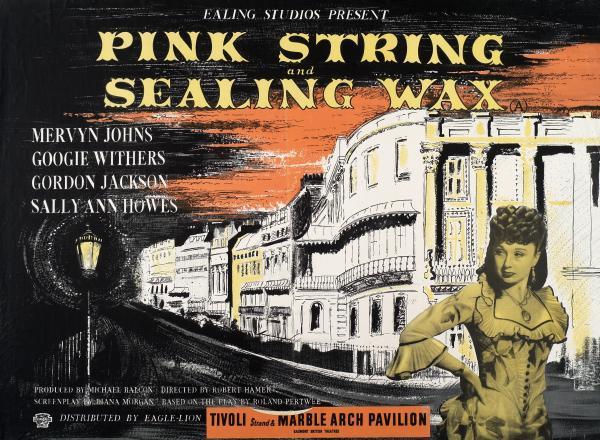
Pink String and Sealing Wax (1945)
Director: Robert Hamer
Starring: Googie Withers, Mervyn Johns, Gordon Jackson, Jean Ireland
Set in Victorian Brighton, Pink String and Sealing Wax is a family melodrama full of frustrated desire and murder. The film follows the strained household of a strict chemist and the dangerous consequences that unfold when his son becomes entangled with a pub landlady trapped in a violent marriage.
The poster was designed by John Piper, one of the leading British artists of the mid-20th century. Rather than presenting Brighton as a cheerful seaside resort, Piper drew on the town’s Regency architecture, Victorian shopfronts and faded decorative details to create something more atmospheric and unsettling. It was a natural fit for an artist fascinated by Britain’s architectural past. During the war, Piper had travelled across the country recording churches, streets and historic buildings threatened by bombing and modernisation.
2
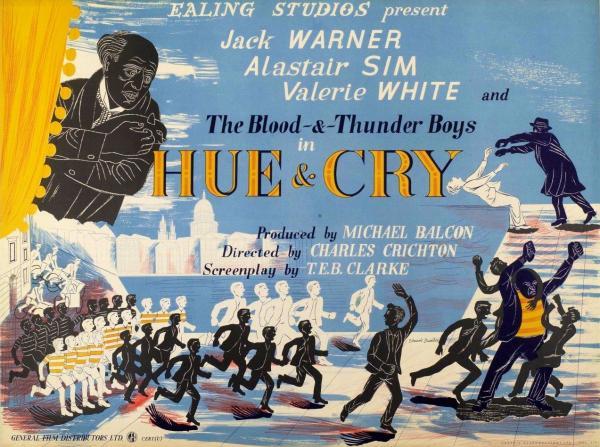
Hue and Cry (1947)
Director: Charles Crichton
Starring: Alastair Sim, Jack Warner, Valerie White, Harry Fowler
Often described as the first true Ealing comedy, Hue and Cry follows a group of London schoolboys who discover that criminals are using a children’s comic to send coded messages. Rather than waiting for the adults to solve the mystery, the boys organise themselves into a comic-book army and set out to defeat the crooks.
The poster for Hue and Cry shows how Ealing’s advertising department could match a film to an artist whose visual language felt completely natural to the film’s world. Edward Bawden was a painter, illustrator and graphic designer whose work for the Curwen Press, Shell, London Transport and Fortnum & Mason was witty, economical and unmistakably English. His restricted palette of blue, black and white, punctuated by vivid red and yellow, gives the poster clarity and energy.
Writing for the BFI, curator Nathalie Morris declared Hue and Cry her favourite Ealing Studios poster:
“S. John Woods gave Bawden a completely free hand. He was sent still photographs but didn’t visit the set or see the completed film before designing the poster. Bawden later wondered if he should have been given more guidance, but I don’t think so. The poster manages to be quintessentially Bawden-esque while also conveying something of the film and the moment at which it was made. Director Charles Crichton was delighted with the result, feeling it perfectly captured the atmosphere he was trying to create, and the pair were successfully matched again for 1953’s The Titfield Thunderbolt.”
3
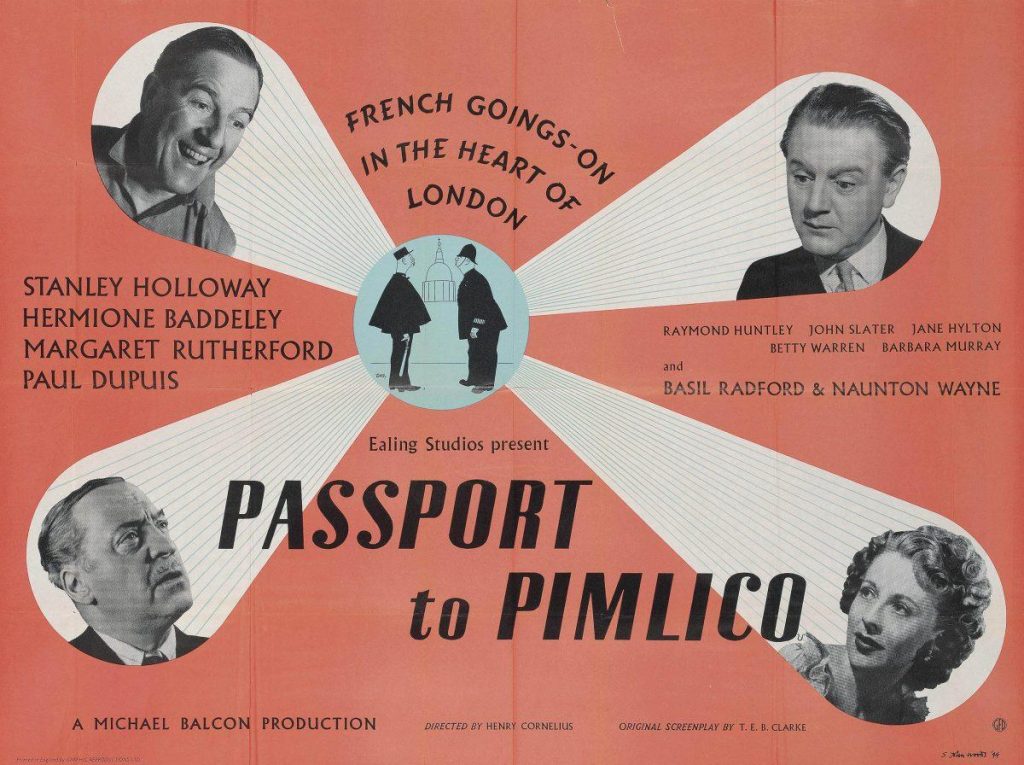
Passport to Pimlico (1949)
Director: Henry Cornelius
Starring: Stanley Holloway, Margaret Rutherford, Hermione Baddeley, Paul Dupuis
One of the defining Ealing comedies, Passport to Pimlico begins when a wartime bomb uncovers treasure and documents proving that part of Pimlico legally belongs to the Duchy of Burgundy. Suddenly exempt from rationing and post-war restrictions, the neighbourhood becomes a tiny independent state in the middle of London.
The Passport to Pimlico poster is a useful example of S. John Woods not only commissioning artists for Ealing but also shaping poster designs himself. For this post-war comic fantasy, Woods created the poster design and brought in Nicolas Bentley for the cartoon illustration. Bentley, who also illustrated T. S. Eliot’s Old Possum’s Book of Practical Cats, gives the poster a comic lightness that suits the film.
4
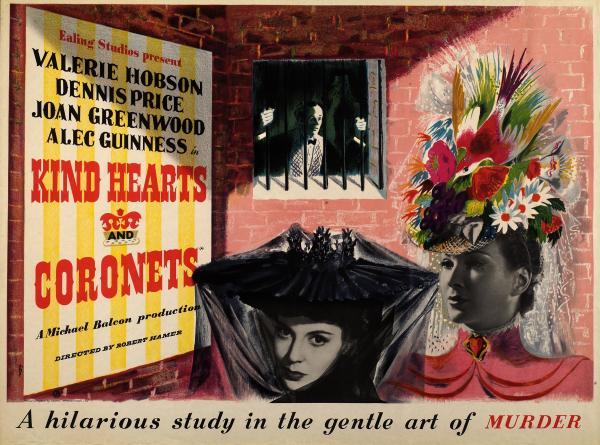
Kind Hearts and Coronets (1949)
Director: Robert Hamer
Starring: Dennis Price, Alec Guinness, Joan Greenwood, Valerie Hobson
One of Ealing’s darkest comedies, Kind Hearts and Coronets follows Louis Mazzini, the son of a woman disowned by an aristocratic family. Determined to avenge this and inherit the family dukedom, Louis calmly sets about murdering the relatives who stand between him and the title – all played, famously, by Alec Guinness.
With Kind Hearts and Coronets, Ealing again moved away from the standard design of film posters: stars, genre cues, dramatic scenes and explanatory narrative. The poster by James Fitton instead shows the diversity and eccentricity of 19th-century lettering, a striking contrast to the utilitarian typefaces associated with wartime propaganda. Rather than presenting the plot, the poster uses period typography and decorative design to evoke the world of social status that the film explores.
5
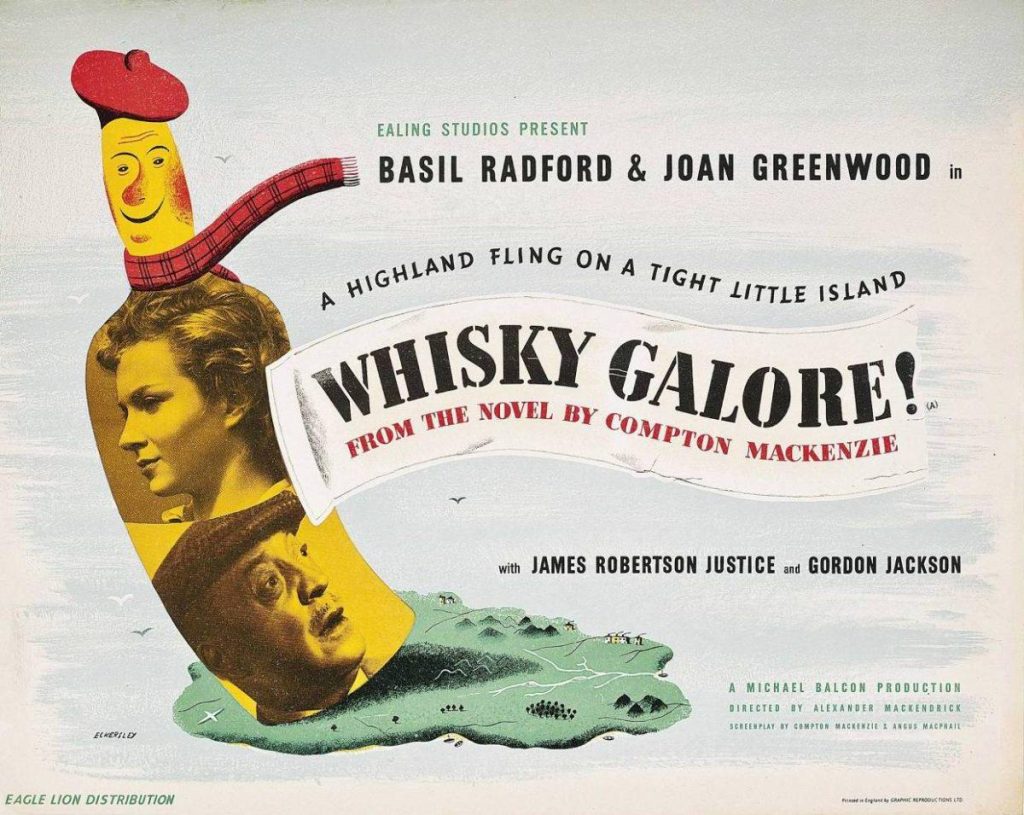
Whisky Galore! (1949)
Director: Alexander Mackendrick
Starring: Basil Radford, Joan Greenwood, Bruce Seton, Gordon Jackson
Alexander Mackendrick’s directorial debut is set on a fictional Scottish island during wartime and food rationing. When a ship carrying thousands of cases of whisky runs aground nearby, the islanders seize the opportunity to rescue its cargo, much to the frustration of the authorities.
The Whisky Galore! poster was designed by Tom Eckersley, one of the most celebrated British poster artists of the mid-20th century. Eckersley’s work was defined by economy: bold, flat areas of colour, simplified geometric forms and the ability to communicate an idea with immediate clarity. Having trained at Salford Art School, he moved to London in 1934 and worked on commissions for London Transport, Shell, the BBC, the Ministry of Information and the General Post Office, later becoming Head of Design at the London College of Printing. For Whisky Galore!, his simple graphic style avoids realistic scenery and detailed storytelling, turning a humorous idea into a clear and memorable image.
6
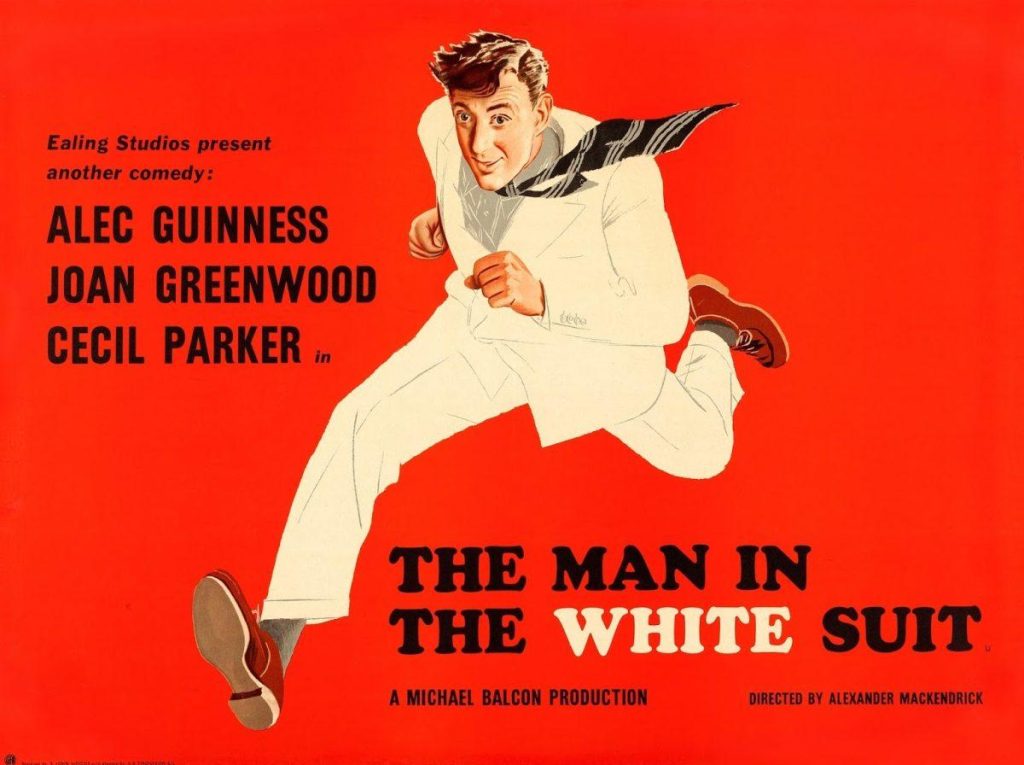
The Man in the White Suit (1951)
Director: Alexander Mackendrick
Starring: Alec Guinness, Joan Greenwood, Cecil Parker, Michael Gough
Alec Guinness stars as Sidney Stratton, an idealistic chemist who invents an indestructible, dirt-repelling fabric. What seems like a miracle of progress quickly becomes a threat to factory owners and workers, who realise that a cloth that never wears out could destroy the textile industry.
The poster for The Man in the White Suit is graphic and confident. The poster shows the film’s central idea as a bold image; Alec Guinness in a luminous white suit, standing against a vivid red background. The design has been associated with Woods and A. R. Thomson, an artist and illustrator, and it reflects Woods’ wider belief that Ealing posters could be designed as striking images in their own right.
7
The Lavender Hill Mob (1951)
Director: Charles Crichton
Starring: Alec Guinness, Stanley Holloway, Sid James, Alfie Bass
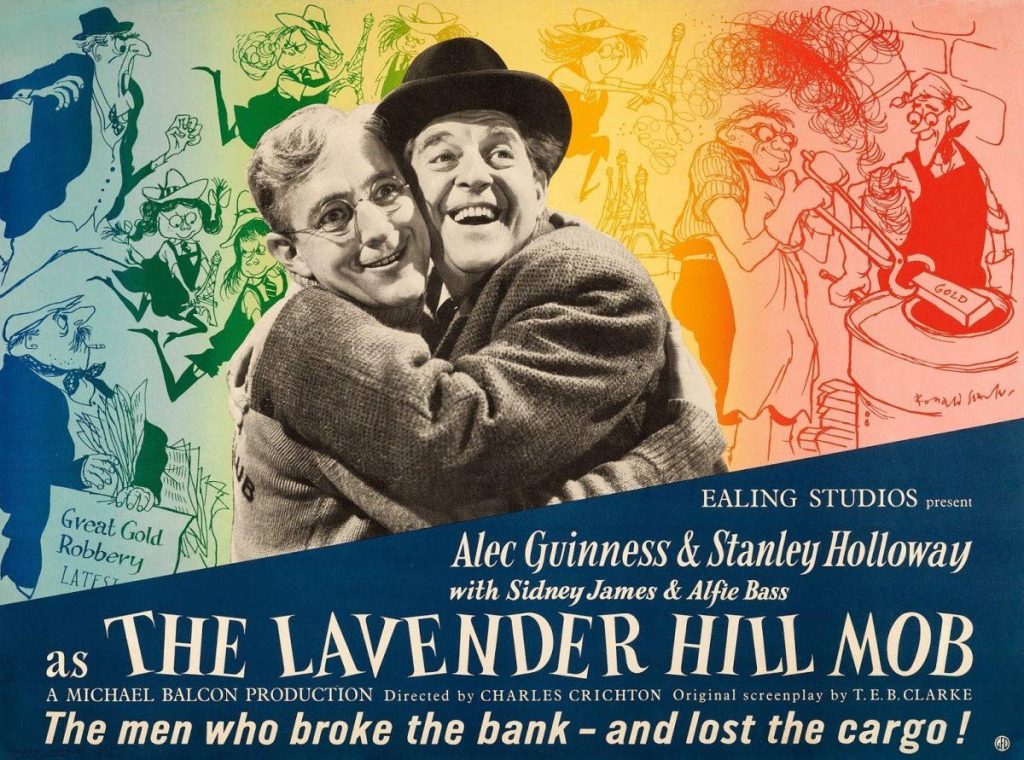
This classic heist comedy stars Alec Guinness as Henry Holland, a mild-mannered bank clerk who supervises deliveries of gold bullion. Tired of his ordinary life, he joins forces with a souvenir manufacturer to steal the gold and smuggle it abroad, disguising the gold as miniature Eiffel Towers. The film itself won the Academy Award for Best Writing, Story and Screenplay and a BAFTA for Best British Film.
The poster was designed by S. John Woods, with illustrations by Ronald Searle. Searle’s spiky, anarchic style is perfectly matched to this comic caper and much of the poster’s appeal lies in how little it resembles the imagery of a crime thriller.
8
The Cruel Sea (1953)
Director: Charles Frend
Starring: Jack Hawkins, Donald Sinden, Denholm Elliott, Stanley Baker, Virginia McKenna
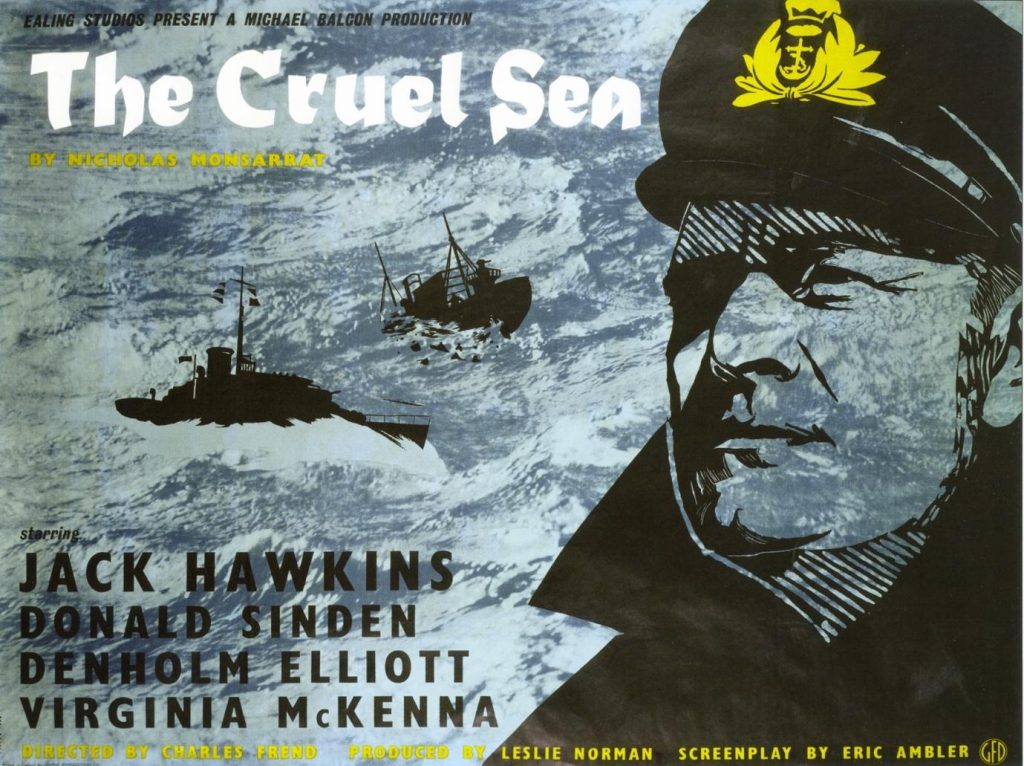
Based on Nicholas Monsarrat’s bestselling novel, The Cruel Sea is one of Ealing’s major war films. It follows the crew of HMS Compass Rose through the Battle of the Atlantic, focusing on endurance, fear, command and the brutal moral choices faced by the people escorting convoys during the Second World War.
The poster has been attributed to Charles Murray, a Scottish artist-printmaker with a strong background in etching and engraving, trained in Glasgow and Rome, with work held by Tate and the National Galleries of Scotland. His background is printmaking. He uses imagery of water in this poster, with the profile of Jack Hawkins and naval ships etched into stormy waves.
9
The Ladykillers (1955)
Director: Alexander Mackendrick
Starring: Alec Guinness, Cecil Parker, Herbert Lom, Peter Sellers, Danny Green, Jack Warner, Katie Johnson
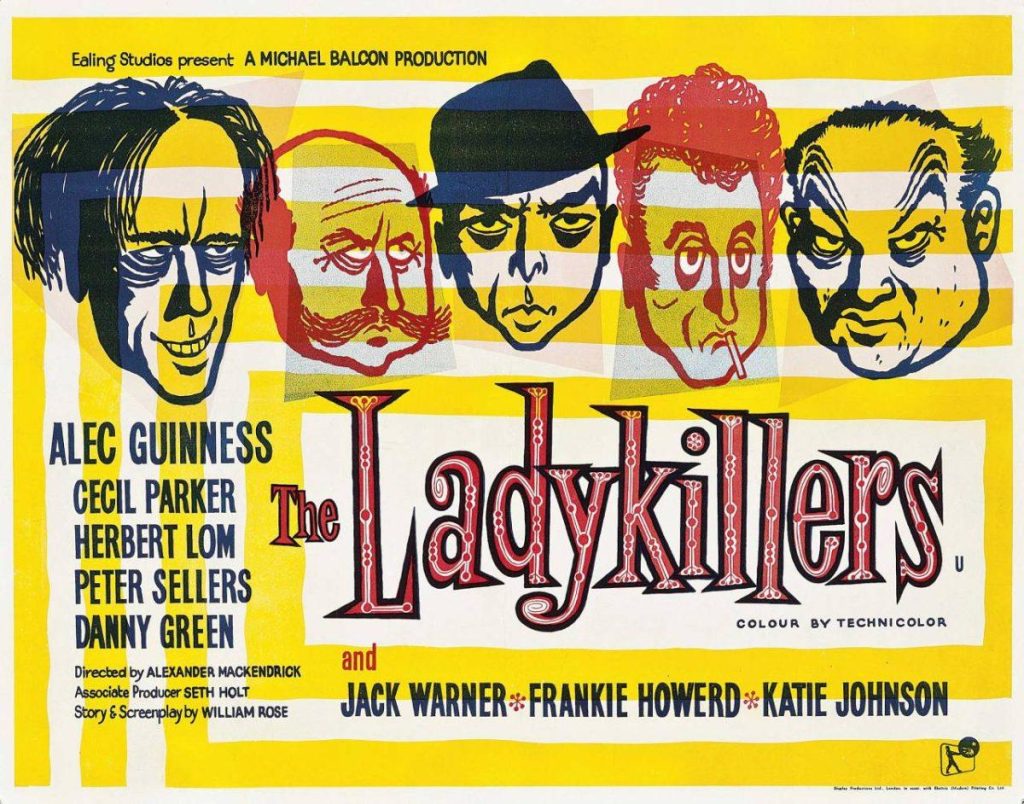
A masterpiece of black comedy, The Ladykillers follows a gang of criminals who rent rooms from the apparently harmless Mrs Wilberforce while planning a robbery. When she discovers what they are up to, the gang’s attempts to silence her collapse into paranoia, incompetence and farce.
The Ladykillers poster was designed by Reginald Mount, one half of the influential Mount/Evans design partnership with Eileen Evans. Mount’s background in public-information design is important. In his film posters, he used the clarity, bold colour and graphic design associated with post-war government and communications posters. For Mackendrick’s black comedy, that is turned into something more sinister and comic. The criminals are presented as a set of grotesque faces, stylised almost into symbols of criminal foolishness. The composition gives them an immediate visual identity – funny, threatening and already almost defeated – capturing the film’s balance of menace and farce while showing how Ealing used the language of modern graphic design in popular cinema.
10
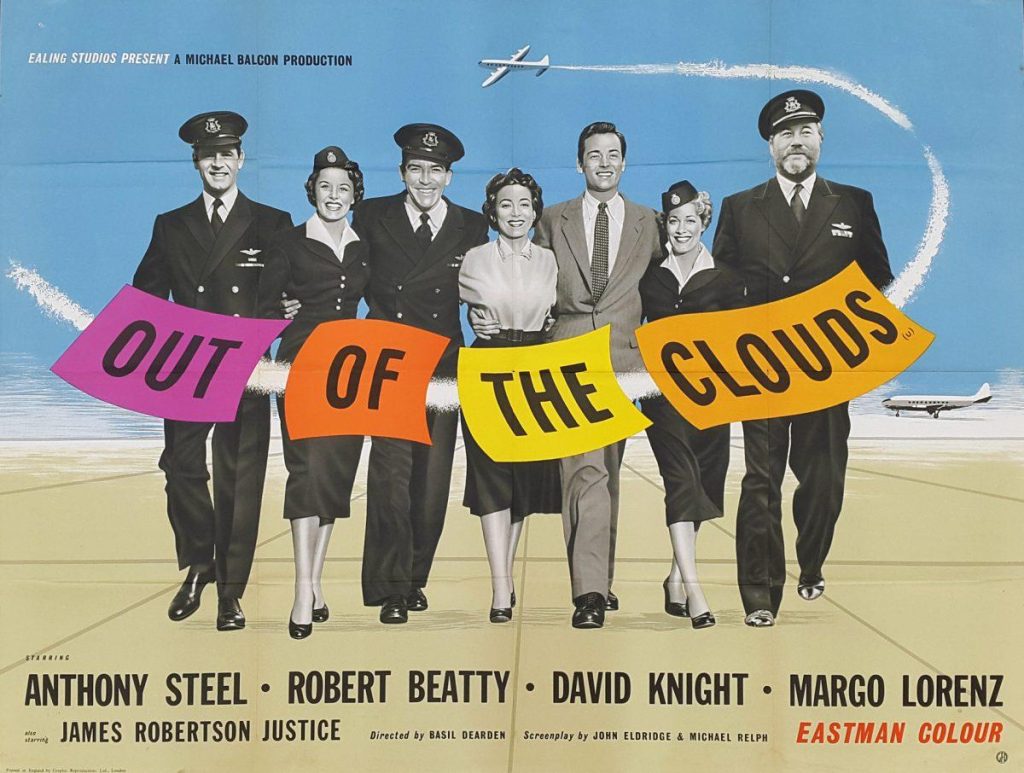
Out of the Clouds (1955)
Director: Basil Dearden
Starring: Anthony Steel, Robert Beatty, James Robertson Justice, David Knight, Margo Lorenz
Out of the Clouds shows Ealing looking beyond our local streets. Set over the course of a busy day at London Airport (now Heathrow), it follows the lives of passengers, pilots and airport staff as personal dramas unfold against the backdrop of post-war air travel. The publicity artwork has been credited to Dante Manno, an Italian illustrator and film-poster painter active in the post-war period.